

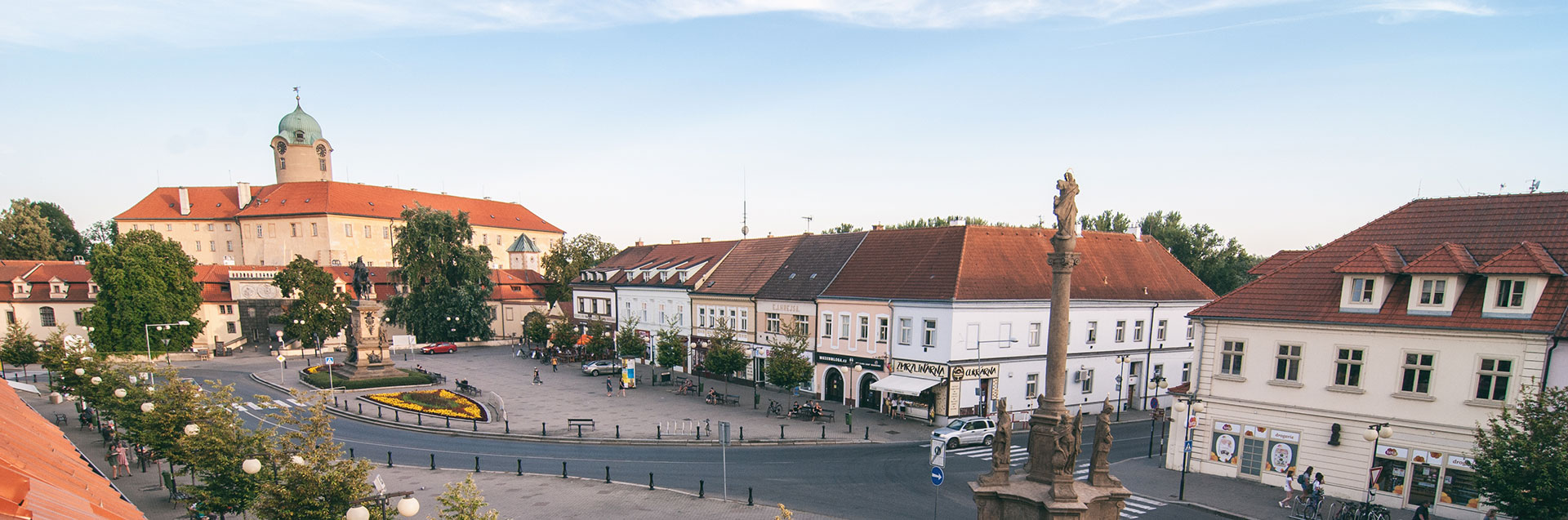
Poděbrady is best known as a spa town where heart diseases are treated. However, its location along the Elbe River in a flat landscape offers much more for leisure activities beyond just relaxing in the spa. Wherever you head from the square, you'll find something interesting worth seeing.
In the city center, you might even feel like you're in a small Amsterdam, as locals ride bikes to work, shopping, or for fun. They’re not deterred by rain. During a walk along the embankment, you might even spot seagulls. We’ve prepared some tips for you on places to visit during your stay in our royal town. We hope Poděbrady becomes a place you hold dear and will enjoy returning to.
HISTORY
How did Poděbrady get its name? Historical sources suggest that long ago, before the establishment of the Czech state, a trade route ran through the area, connecting Prague to Poland. This route crossed a dense network of river branches at a ford. Near it, a settlement was formed. Hence, the name Poděbrady – "pode brody" (by the fords). More about the life of the inhabitants of the Elbe River Basin from the very beginning can be discovered in the local museum, which is located in the building of the oldest school in Poděbrady.
Polabské museum Poděbrady, Na Dláždění 68, 290 01, Poděbrady
Phone: +420 325 612 640
PODĚBRADY CASTLEK
Poděbrady Castle is featured on nearly every postcard of our town. Originally, it was a castle founded in the 12th century. The first king to live there was Přemysl Otakar II. Each subsequent owner renovated and modified the stone water castle to suit their needs. The current Baroque form of the castle dates back to the 18th century. The last private owners were Prince Arnošt Filip Hohenlohe of Schilingsfürst and his wife. They lived in the castle until 1912. Today, you can visit the Memorial to King George of Poděbrady every day, except on Mondays. This memorial commemorates the legacy of the Czech king, whose 600th anniversary of his birth is being celebrated this year.
The memorial also houses a gallery showcasing the works of sculptor Bohuslav Schnirch, the creator of the monument to King George of Poděbrady in the town square. In the castle's cellar, you can also visit the Lapidarium.
Memorial to King George of Poděbrady, Castle – former chapel
Phone: +420 737 539 375
SPRINGS
The first mineral spring was discovered by dowser Karel von Bülow in 1905 at the request of the owner of the Poděbrady estate, A. F. Hohenlohe. The Poděbrady mineral water is sourced from deep wells and has a temperature of around 14°C. Throughout the town, there are several drinking fountains, with a total of seven located across the city, each one a small architectural work of art. Although the composition of the healing mineral water is virtually identical, each spring has its own distinct taste. Get a porcelain spa cup and find your favorite one.
Moučná – behind the train station in the Žižkov area
Trnka – in the northern part of the spa park near the train station
Rieger – pavilion on Rieger Square
Hohenlohe – in the castle moat
Boček – Libenská Colonnade in the middle of the spa park
Eliška's Spring – in the spa park near the T. G. Masaryk statue
Svatojánský Spring – in Kubovy Sady Park along the riverbank near the weir
You can also enjoy the mineral water inside the following establishments: Hotel Libenský, Spa Hotel Felicitas, Park Spa Hotel, Bellevue Tlapák Hotel, Zámeček Hotel, Winter and Summer Spas, and the Mír Sanatorium.
ARCHITECTURE
Where else will you find a square full of greenery? The central spa park, connecting Jiřího Square with the train station, is rectangular in shape, with Libenská Colonnade at its center, featuring a glass and concrete dome. This covers the Boček Spring, which is the most frequently visited spring by the city's guests. The park is home to not only botanically interesting species of trees and shrubs but also a variety of valuable sculptures. The most famous of these is Leda and the Swan, located in the northern part of the park. The spa park, with its water features (illuminated fountain, water cascades), is a popular meeting place for locals and tourists. It is truly the center of Poděbrady's social life. While strolling along the rectangular streets on its sides, you can admire the architectural decoration of the facades of family houses and guesthouses, built during the founding of the spa. This period corresponds to the Art Nouveau and Art Deco styles. In the very center, on T. G. Masaryk Square, you’ll find spa hotels, each a unique architectural masterpiece, mostly from the period of functionalism.
Key Buildings:
Vila Kouřimka – Art Nouveau villa (architect Josef Fanta, 1915), T. G. Masaryk Square 256/40
Obereigner's Villa – Neo-Renaissance Art Nouveau villa (architect Josef Fanta), Havlíčkova 1/5
Libenská Colonnade (architect Vojtěch Kerhart, 1936), T. G. Masaryk Square – Central Spa Park
Water Tower – Functionalist technical monument (architect František Janda, 1929), S. K. Neumann Gardens
Train Station Building – Functionalist building (architect Vojtěch Krch, 1931), T. G. Masaryk Square 210/17
Hotel Bellevue Tlapák – Functionalist building (architect František Tlapák, 1935), T. G. Masaryk Square 654/2
Spa House Libenský (Jiří Justich, 1912), T. G. Masaryk Square 437/1
Old Town Hall – Renaissance bourgeois house (16th century), Jiřího Square 41/12
Sokolovna (Gymnasium) (architect František Krásný, 1929), Tyršova 26/9
Hydroelectric Power Station with Weir – Neoclassical technical building (architect Antonín Engel, 1919), Labská 71
Radiotelegraphic Station – Rondocubist technical complex (architect Bohumír Kozák, 1923), Na Zálesí 530
Flood Bridge (26 sandstone arches, 1831), floodplain on the left bank of the Elbe River
Sacral Buildings:
Marian Column (sandstone sculpture commemorating the plague epidemic, 1765), Jiřího Square
Church of the Exaltation of the Holy Cross (Gothic church from the 14th century), St. Agnes Square, open daily
Statue of St. John Nepomuk (copy of the Baroque statue from 1761), Pražská Street behind the flood bridge
Miners’ Chapel – Church of the Assumption of the Virgin Mary (founded in memory of the Kutná Hora miners executed here, 1516), Na Zámostí 57, church and bell tower accessible in July and August daily from 10:00 AM to 12:00 PM and 1:00 PM to 5:00 PM; in September, only on weekends from 10:00 AM to 12:00 PM and 1:00 PM to 5:00 PM.
FOR CHILDREN
Children's Playground near the bike path – at the corner of Labská and Na Kopečku streets, near the Svatojánský Spring in Kubovy Sady.
Poděbrady Train – tourist sightseeing train (1-hour ride around Poděbrady and its surroundings),
boarding location: Kubovy Sady by the lock, phone: +420 602 403 029.
Skupice-Huslík Educational Trail – ten information panels about the local flora and fauna, placed from the lock at the Elbe River, along a blind arm of the Elbe called Skupice, to the confluence of the Elbe and Cidlina rivers, and back to Poděbrady. Length: 7.5 km.
Lego Museum (3,000 Lego models + children’s corner), Jiřího náměstí 7, phone: +420 773 737 503.
Opičkov Playroom (children’s café, playroom, children’s corner), Husova 25/11, phone: +420 737 734 702.
Film Legends Museum (collection of the most famous movie, comic, and fairy tale characters), Jiřího náměstí 36/18, open daily from 9:00 to 18:00, phone: +420 777 603 603.
TOURIST ATTRACTIONS
Boat Trips on the Elbe – Poděbrady is closely tied to boat rides through the floodplain landscape of the Elbe. The "Král Jiří" excursion boat takes you to the confluence of the Elbe and Cidlina rivers, or to Nymburk. Circular tours operate according to the timetable available at the pier on the Castle Embankment. The first boat departs at 11:00, with the last departure at 17:00. At least ten passengers are required for the trip to proceed. More information: +420 603 886 582.
Flower clock
Located at the corner of the Central Spa Park in front of the Libenský Spa House since 1936. The digits of the clock are made from a low succulent plant called Echeveria. The local gardener replenishes them daily, including placing the date next to the clock. Photos taken in front of the flower clock are a must-see when visiting Poděbrady.
Poděbrady Dwarf
A cast iron fairy tale figure located just behind the flower clock. The dwarf, made in 1938, strikes the time at a large mushroom. It has recently undergone successful restoration.
PoděbradyDiorama
A structure resembling a poster column at the entrance to the Central Spa Park from Jiřího náměstí. Insert a coin to raise the curtain and watch a performance inviting visitors to Poděbrady with musical accompaniment.
Poděbrady Brewery
Beer has been brewed in Poděbrady since 1502. The brewery was founded 29 years later. The brewery entrance is located just a few steps from the main square. The historic building is also accessible from the Elbe River side, where you can find outdoor seating at the "Restaurant in the Brewery."
You can also enjoy beer baths at the Beer Baths in the old ice storage building. For coffee, visit the Espresso Bar of Amáres Coffee Roastery, located within the brewery complex.
Sklárny Crystal Bohemia Glassworks
The largest producer of lead crystal in the Czech Republic offers tours of its production. You can visit the glassworks on weekdays throughout the year by booking in advance at +420 325 602 234 or
via e-mail: exkurze@crystal-bohemia.com.
SWIMMING
You can swim at the natural swimming pool Jezero Poděbrady. It has a sandy beach, grass areas, pedal boats, sunbed rentals, several refreshment stands, and beach volleyball or soccer courts. You can also take a dip in the nearby Jezero u Pískové Lhoty. located a few kilometers from Poděbrady towards Nymburk, or enjoy a covered hotel pool in winter.
CULTURE
Poděbrady hosts various events throughout the year, including musical and social events. On the colonnade, you can attend fashion shows, enjoy open-air concerts, sample new tastes at street food festivals, or spend the extended weekend at the Soundtrack music and multimedia festival.
NEARBY TOURIST ATTRACTIONS
Confluence of the Elbe and Cidlina Rivers, popular tourist restaurant is located here. After dining, you can explore the Libický Luh Nature Reserve. a large floodplain forest home to black storks and kingfishers. The forest contains a variety of native trees and wetland areas.
Slavníkov Castle
The beginnings of the Slavníkov fortified settlement date back to the early 9th century and is near the confluence of the Elbe and Cidlina. Archaeological findings suggest the area was an important trade route from Bohemia to Silesia and beyond to the Baltic Sea.